About UsOur ServicesPatients and PhysiciansMake a GiftNews & EventsContact

A Letter from Dr. Harold Freeman, M.D.
A Message from Ralph Lauren
10 Facts About the RLCCCP
Fighting for Your Health
House Call: Answers to Your Health Questions
45 Superfoods for a Better Life
Drop Fat at a Glance
Get Back in Shape
40 Ways to Improve Every Day of the Week
Slimmed-down Soul Food
Resource Guide
Guest Book


Monica Williams, 70
Nurse’s aid,
mother of four


When this proud sister from Grenada was diagnosed with colon cancer, she didn’t tell her family. In fact, the first they will learn of it will be when they see this page.

“I did not want anyone crying,” says Monica Williams. “I said, ‘God, I leave this cancer in your hands; Lord, guide the doctors.’”

Williams says she had none of the typical symptoms of colon cancer—bloating, stomach cramps, weight loss and constipation—but she did have a dream: In her sleep, she saw a friend who had recently died. “She told me, ‘Monica, you have the cancer.’”

So Williams went to her doctor and scheduled a colonoscopy at North General Hospital, which revealed a mass in her colon. The Ralph Lauren Center for Cancer Care and Prevention managed her cancer treatment, which involved surgery and chemotherapy. Throughout treatment, Williams refused to wear the hospital gowns, choosing fashionable robes instead. She changed her diet, and started eating cabbage, broccoli and papaya and drinking lots of water, which she felt helped with recovery. Also crucial to her success, she says, were the patient navigators at the center.

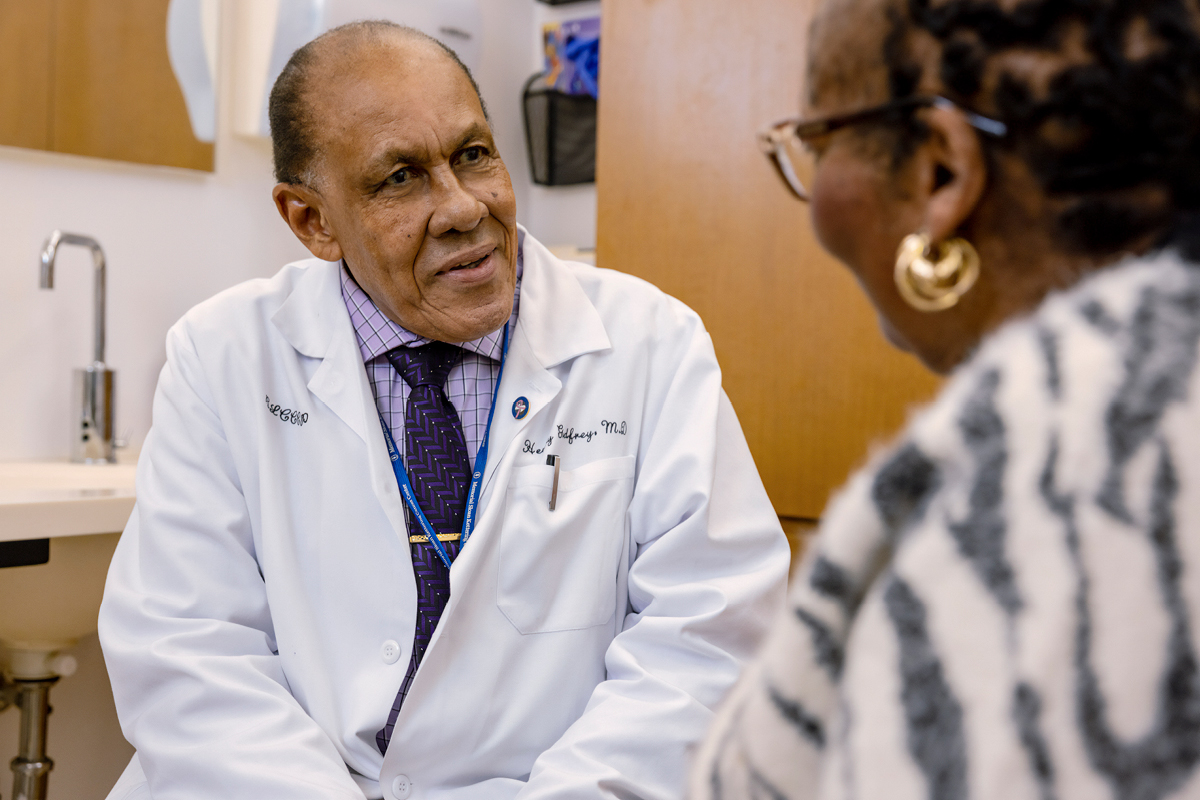
“Everyone at this place was good to me. They told me everything I was supposed to do,” says Williams. “Maude [a patient navigator] is like a daughter to me. She calls me ‘Mom.’ I thank the Lord for her, for Dr. Godfrey, for all of them, every day.”

Rubbing the rings on her left hand, Williams drifts back to her childhood in Grenada. “My father always told me, ‘Never think that you’re sinking, always think you’re floating,’” she says. “That’s how I live my life.”

—Jenesis Scott


Calvin Martin, 68
Cofounder of Brother to Brother prostate-cancer support group


Men don’t talk about their health like women do, and that’s a problem,” says Calvin Martin, standing in a pew at Convent Avenue Baptist Church in Harlem. Martin was one of those men. When a screening at age 54 indicated he had prostate cancer, he “didn’t dare” tell anyone but his wife and mother. Why? “In my opinion, there was a stigma attached to having prostate cancer.”

But his attitude changed when someone gave him a copy of Ebony magazine that showed Desmond Tutu, Harry Belafonte, Marion Barry and Sidney Poitier next to the headline: “What do these men have in common?” “I thought, if those guys can talk about it, so can I.”

Martin quickly found many men at church who had prostate concerns and were suffering in silence. So together with Ron Baker, a prostate-cancer survivor, and Blanch Bouie from the American Cancer Society, they founded a support and outreach program called Brother to Brother in Harlem. Based on the ACS’s Man to Man program (800-227-2345), Brother to Brother is tailored to the needs of the community. “Black brothers contract this cancer earlier in life than their white counterparts and so sexual function is a concern of theirs,” Martin says. “There’s also a concern about treatment costs and insurance that may not apply to white men. So we needed a different presence in our community.”

To learn more about the 200-member Brother to Brother program, contact the ACS Upper Manhattan Unit, 1845 Amsterdam Ave., 212-283-4125.

Martin is a firm believer that at age 40 black men should have both the digital rectal exam (DRE) and a PSA blood test. “I always tell brothers that one is not good without the other.” The DRE is a simple examination in which a doctor places a gloved finger in the rectum to feel for irregularities on the prostate gland.

“The only way to know is to be checked,” says Martin. “We have to tell men that three seconds of minor discomfort may end up saving their lives.”

—Jeff Csatari


Hope Williams, 41
Postal Worker, Mother of Two


During a self-examination, Hope Williams felt something in her breast. She had just given birth to her second child, and her doctor said it was a normal, post-pregnancy symptom. But the lump grew, and so did her concerns.

A free mammogram at the Harlem Health Center detected a possible problem, and a lumpectomy (surgical removal of the lump) confirmed her fears: At age 35, Williams had breast cancer. She was referred to Jenny Romero, M.D., at the Ralph Lauren Center for Cancer Care and Prevention. “From the door to the doctor,” says Williams, “everyone was warm and friendly. It was almost like going to a friend’s house.” The patient navigators helped her find financial assistance; during her four months of chemotherapy, they sat right beside her. They introduced her to a weekly peer support group, where she found women who understood exactly what she was going through.

“Being sick, some days you’re more down than others and you need that inspiration,” she says. At the Ralph Lauren Center, she found comfort and support. They helped her laugh and smile. Williams is now cancer free, and she credits the center for her triumphant victory. “They gave me a second life.”

—Rosalind Lawton


Hassan Yasin, 37,
and the Bar-Tendaz

Fitness and anti-drug/alcohol activists


Hassan Yasin has triceps that you can crack walnuts on. He can do things on a pull-up bar that would make Olympic gymnasts jealous. No wonder this affable gentleman with cornrows and muscles bursting through his T-shirt is treated like a superhero by youth on the street. No wonder kids wouldn’t dream of cutting gym class when he and his gang of chiseled strongmen bring their message of physical fitness and alcohol awareness to schools in New York and beyond. They are the Bar-Tendaz. “We get drunk on the [pull-up] bars; we don’t believe that Bud makes you wiser,” he says.

The Bar-Tendaz calisthenics program started eight years ago when Yasin was doing gang-prevention work in the schools. “With all the budget cuts for physical fitness in the public schools and community centers, kids are not getting exercise and the youth are obese. Idleness inevitably leads to crime, alcohol and drugs,” he says. Yasin decided to try to make a difference for youth by building a program around functional exercises that you can do anywhere—pull-ups, push-ups and jumping jacks. “Jack LaLanne exercises,” he says.

Today, the Bar-Tendaz offer workshops in leadership, nutrition, fitness, self-empowerment and more. The men on the bars have adopted comic book hero–style names—Code Red, Transformer, A.R., Metaphysics and Chaos—which they say helps them connect with kids. “If you give the youth something they can own, so they can challenge their elders in jumping jacks or do amazing things on a straight bar, suddenly they are getting positive attention,” says Yasin. “Right now, so many youth have low self-esteem or no self-esteem, and that leads to toxic thinking.”

—Jeff Stevenson


Willie Walker
Superintendent, Adam Clayton Powell Jr. State Building, advocate for a healthy Harlem


If you want to know where to find the best of Harlem, visit Willie Walker at the State Office Building. Since being appointed by Governor Pataki in 2005, Walker has worked to make the building’s services more accessible to the community. Walker has worked with Mt. Sinai Hospital, Harlem Hospital, the Centers for Disease Control, the NYC Department of Health and Mental Hygiene and the Harlem Chamber of Commerce on a host of initiatives to improve the health of minorities. And he is a founder of the Harlem SummerStage.

“Education is the greatest challenge to the health and welfare of those living in Harlem,” says Walker. “Certain food choices and attitudes toward the health-care system are so deeply rooted in our culture that we have to help people to start thinking there is a better and healthier way of living.” A healthier Harlem also starts with making better food choices more convenient and accessible for the people. “There aren’t enough supermarkets here where people can get good, healthy food, so they are forced to eat at bodegas. Why don’t we put some supermarkets where the banks are?”

—Anastasia Wright


David Tineo, 28
Brother, grandson, peace officer


It was just a bump on my neck,” says David Tineo. “A little swelling, but I had a feeling it was cancer.” He went to a doctor, who told him not to worry and handed him a prescription. “I refused the medication. I told him I wanted a biopsy immediately.”

A friend who had breast cancer told Tineo about the Ralph Lauren Center, and he scheduled an appointment. Tests showed that Tineo had Burkitt’s lymphoma, a form of non-Hodgkin’s lymphoma.

The news shocked Tineo, who had no other symptoms and is trim and fit. (He does body-weight exercises and runs about four miles a day.)

“I lost it for a bit there when I got the report,” he says. “But then you just have to take it head-on with the help of your friends and family,” he says, smiling at his sister, Emely Diaz. They live with their grandmother Ana in Washington Heights.

“The lesson I’d like to share is that you have to take charge of your health. Don’t wait. Follow your instincts and get checked out.”

The Ralph Lauren Center scheduled chemotherapy treatments starting in April, which the young man handled very well. He continues to visit the center for regular checkups. “It’s like family at the center,” he says. “They call me by my first name.”

“Yeah, and the nurses are sad when he leaves,” laughs Emely.

—Frances Fabian

Download A Printer Friendly Version Of This Section


Privacy PolicyTerms of UseHIPAA Privacy PolicyCopyright 2010 Ralph Lauren Center